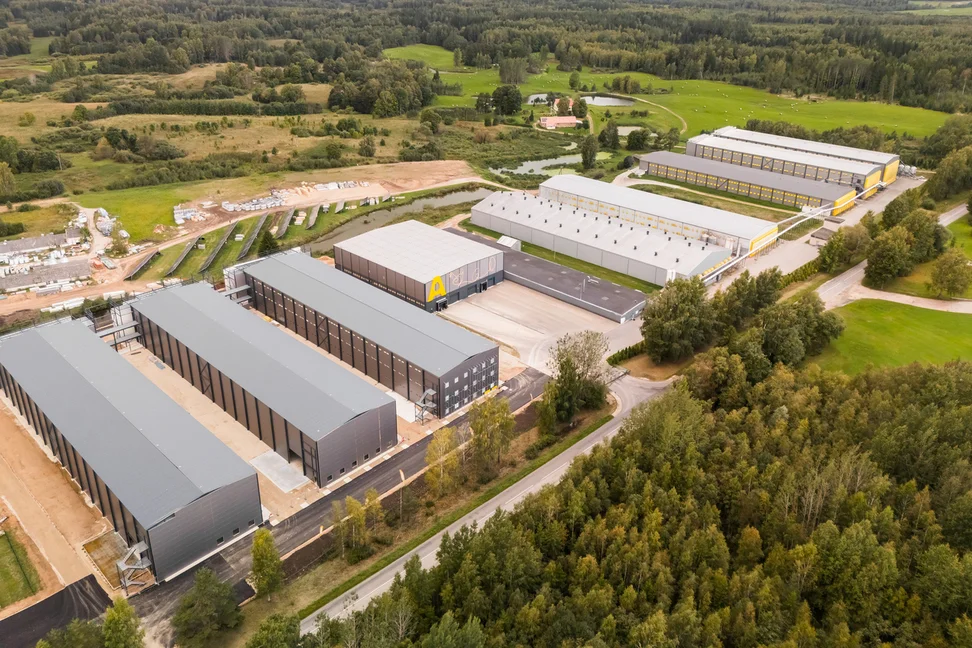
Alūksnes Putnu Ferma Ltd., part of the European agri-food group Agrova, has secured EUR 33 million in financing to implement a major development project and refinance its existing debt. The financing is being provided by Swedbank and Latvia’s state-owned development finance institution ALTUM, with ALTUM’s funding granted under the Large Investment Programme to finance the construction of production facilities and the purchase of equipment.
As part of the project, three new laying hen houses with a total area of 7,380 m² are being constructed in Alūksne, alongside the modernisation of the egg grading and packing centre and the development of an organic fertiliser production facility. In Preiļi Municipality, new pullet-rearing infrastructure is planned, increasing the efficiency of the entire production chain and strengthening the company’s operational independence. Upon completion of all projects, the company’s annual egg production will increase by 56%, from the current 180 million eggs to approximately 280 million eggs.
Hermanis Dovgijs, Chairman of the Management Board of Alūksnes Putnu Ferma Ltd., said: “The involvement of two major financial partners enables us to undertake one of the most ambitious development phases in the company’s history. The financing will allow us not only to expand our production capacity and modernise our infrastructure, but also to optimise the company’s financing structure and establish a solid foundation for future investment. By expanding production in Alūksne and Preiļi municipalities, we will strengthen our export potential, create new jobs and demonstrate the ability of Latvia’s regions to develop modern and internationally competitive food production.”
Swedbank has provided Alūksnes Putnu Ferma with total financing of EUR 25 million, covering both the implementation of the development project and the refinancing of the company’s existing debt, thereby significantly reducing interest costs.
Elīna Salava, Head of Large Corporate Banking at Swedbank, said: “Alūksnes Putnu Ferma’s development plans demonstrate the company’s ambition to systematically increase production capacity while investing in modern infrastructure and laying hen welfare. Investments of this scale strengthen not only the company’s own position but also Latvia’s food production and export potential. We highly value the professionalism of the company’s management team and are pleased to work alongside ALTUM in providing financing for this important stage of development.”
Under the state aid programme “Loans with a Capital Rebate for Large Investment Projects”, ALTUM has granted Alūksnes Putnu Ferma a loan of EUR 8 million with a maturity of up to 2036. The financing will be disbursed gradually in line with the progress of the project until the end of 2027.
Reinis Bērziņš, Chairman of the Management Board of ALTUM, said: “The Large Investment Support Programme was established to facilitate projects that drive business growth and make a significant contribution to Latvia’s economy. The total project cost is approximately EUR 27 million, of which ALTUM has provided EUR 8 million in the form of a loan with a capital rebate. Once the project targets have been achieved, the eligible portion of the ALTUM loan will be written off, significantly shortening the investment payback period and improving the project’s economic viability. Support instruments of this kind make it possible to implement investment projects whose scale and development benefits would otherwise be considerably more difficult to achieve. Cooperation between public and private financing also plays an important role in delivering the project, helping to bring ambitious and strategically important development plans to fruition.”
The Alūksnes Putnu Ferma development project forms part of the EUR 30 million investment programme launched this year by AS Agrova Baltics in Alūksne and Preiļi municipalities. The programme aims to increase production capacity in response to rapidly growing demand for cage-free eggs in European export markets and to develop one of the most advanced fully integrated egg production complexes in the Baltics.